

Search for the best weight loss supplements and you will find hundreds of products promising faster fat burning, a higher metabolism or effortless appetite control. The useful answer is much narrower. A supplement earns a place in a weight-management plan when it performs a specific job: helping you reach a protein target, making hunger easier to manage, supporting training quality or producing a small, measurable improvement in body composition.
Protein powder has the strongest practical role because it can improve satiety and help protect lean mass during a calorie deficit. L-carnitine, CLA and alpha-lipoic acid have also produced measurable changes in clinical research, although their average effects are modest. Caffeine and green tea can increase short-term energy expenditure, but stimulant dose and timing matter. The right choice depends on the obstacle that is slowing your progress, not on the loudest claim on the label.
What Counts as a Weight Loss Supplement That Works?
“Works” should mean more than making you feel warm, sweaty or energised. A useful weight loss supplement should meet three standards:
- It has a plausible and clearly defined role, such as increasing protein intake, supporting satiety or contributing to energy metabolism.
- The active ingredient and daily dose are stated clearly enough to compare with human research.
- The expected result is realistic. For most non-prescription supplements, that means a small advantage within a consistent nutrition and training plan, not dramatic weight loss by itself.
The NIH Office of Dietary Supplements review reaches the same broad conclusion: evidence varies greatly by ingredient, and many heavily marketed products do not produce meaningful long-term weight loss. The supplements worth considering are the ones with a specific function and evidence that matches that function.
The Best Weight Loss Supplements at a Glance
| Supplement | Main role | What the evidence supports | Best fit |
| Protein powder | Satiety and lean-mass protection | Helps meet higher protein targets and preserve muscle during energy restriction | People struggling to reach protein needs through meals |
| L-carnitine | Fatty-acid transport and energy metabolism | Small average reductions in body weight, BMI and fat mass, especially in adults with overweight or obesity | Active routines built around diet and exercise |
| CLA | Body-composition support | Small changes in body weight, fat mass and fat-free mass across pooled trials | Stimulant-free body-composition plans |
| Alpha-lipoic acid | Cellular energy metabolism and antioxidant support | Small short-term reduction in body weight in pooled clinical trials | Metabolism-focused or carbohydrate-conscious routines |
| Caffeine and green tea | Energy, thermogenesis and fat oxidation | Small short-term effect on energy expenditure and body weight | People who tolerate stimulants and need training energy |
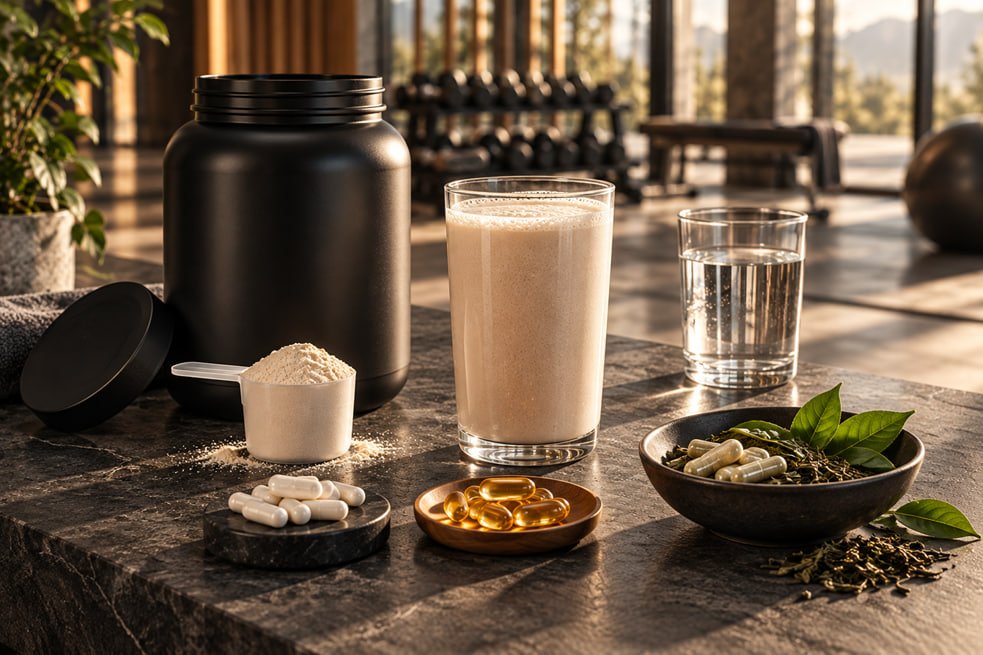
1. Protein Powder: The Most Useful Starting Point
Protein powder does not burn fat directly. Its value is more practical: it makes an effective nutrition target easier to reach. Higher-protein diets tend to improve fullness, and adequate protein helps protect lean tissue while body weight is coming down. That matters because a successful cut should reduce fat without giving away unnecessary muscle.
A shake can be particularly useful at breakfast, after training or during a busy part of the day when the alternative is a low-protein snack. The serving should fit the day’s calorie budget rather than being added on top of meals without adjustment. A powder that provides around 20 to 30 grams of protein, has a clear ingredient list and keeps added sugar under control is usually more useful than a “diet shake” crowded with decorative ingredients.
Whey, casein, egg and well-formulated plant proteins can all work. Choose by digestion, dietary preference and how you plan to use it. Whey is convenient around training, while casein or a thicker blended shake may feel more satisfying when hunger control is the priority.
2. L-Carnitine: A Small Edge for Active Weight-Loss Plans
L-carnitine transports long-chain fatty acids into mitochondria, where they can be used in cellular energy production. That biological role explains why it appears in so many fat loss supplements, but the human evidence is more useful than the mechanism alone.
A 2020 meta-analysis of 43 randomised controlled trials found average reductions of about 1.13 kilograms in body weight, 0.36 points in BMI and 1.16 kilograms in fat mass. The clearest results appeared in adults with overweight or obesity and when supplementation accompanied other lifestyle changes. In other words, L-carnitine can add a modest advantage to a working plan; it does not create the plan.
Standard L-carnitine and L-carnitine tartrate are practical choices for training-centred routines. Acetyl L-carnitine is an acetylated form often selected when mental energy and focus are also part of the goal. Choose one form with a clearly stated daily amount instead of combining several carnitine products. For timing, forms and daily use, read Avitazen’s guide on how to use carnitine for fat burning.
3. CLA: Better Suited to Body Composition Than Fast Scale Loss
Conjugated linoleic acid, or CLA, is a group of fatty-acid isomers naturally present in meat and dairy foods. Supplemental CLA is commonly derived from safflower oil and is usually sold in softgels. It is stimulant-free, which makes it attractive to people who do not want caffeine in a weight-management stack.
A 2024 systematic review and dose-response meta-analysis combined 70 randomised trials involving more than 4,100 adults. Across the full dataset, CLA produced small average reductions in body weight, BMI, waist circumference, fat mass and body-fat percentage, alongside a small increase in fat-free mass. The size of the effect was limited, and the highest-quality studies did not confirm a meaningful reduction in fat mass or body-fat percentage.
That places CLA in a specific category: it is a body-composition supplement, not a rapid fat-loss product. It makes the most sense for someone who already has consistent meals and training, prefers a non-stimulant option and is comfortable judging progress over weeks rather than days. Products such as Yamamoto CLA PRO also make comparison easier by stating the amount of conjugated linoleic acid supplied per daily serving.
4. Alpha-Lipoic Acid for Metabolism-Focused Support
Alpha-lipoic acid, usually shortened to ALA, is involved in mitochondrial energy metabolism and works as an antioxidant in both water- and fat-soluble environments. A meta-analysis of 10 randomised, double-blind, placebo-controlled studies found that ALA produced an average of 1.27 kilograms more short-term weight loss than placebo, together with a small reduction in BMI.
ALA is therefore best viewed as metabolic support with a modest weight-management effect. It is available as a simple product, while formulas such as Lipoic-CR combine alpha-lipoic acid with chromium picolinate. Chromium contributes to normal macronutrient metabolism and the maintenance of normal blood glucose levels, but taking chromium does not automatically create fat loss. Its role is clearer inside a carbohydrate-conscious plan than as a stand-alone “fat burner.”
More complex carbohydrate-control formulas may also combine ALA and chromium with ingredients such as berberis, bitter melon, gymnema and cinnamon. These products serve a different purpose from caffeine-heavy metabolism boosters, so compare them by active ingredients rather than treating every product in the category as interchangeable.
5. Caffeine and Green Tea: Useful, but Easy to Overrate
Caffeine can increase alertness, training drive and short-term energy expenditure. Green tea provides catechins such as EGCG and often contributes additional caffeine. Pooled research has found small reductions in body weight and BMI from caffeine-plus-catechin formulas, but the average change is far smaller than the marketing language around “thermogenic fat burners” suggests.
These ingredients are most useful when low energy is reducing training quality or daily activity. They are a poor fit when they disturb sleep, create a racing heartbeat or simply duplicate the caffeine already coming from coffee, pre-workout and energy drinks. Add the total daily caffeine from every source before choosing a stimulant product. More is not more effective once sleep and recovery begin to suffer.
Supplements That Do Not Deserve Top Billing
Several familiar ingredients remain popular because the promise is easy to sell, not because the results are strong. Raspberry ketones have almost no persuasive human weight-loss evidence. Garcinia cambogia and green coffee bean products have produced inconsistent results, and apple cider vinegar gummies are not equivalent to a controlled nutrition strategy. B vitamins correct a deficiency; they do not accelerate fat loss in someone whose intake is already adequate.
Be equally cautious with proprietary blends that hide the amount of each active ingredient. A long ingredient panel can look impressive while delivering very little of the components that matter. Transparent dosing, a sensible serving and a focused purpose are better signs than the number of ingredients on the front label.

How to Choose the Right Supplement for Your Goal?
Start with the bottleneck in your current plan.
- If hunger and low protein intake are the main problems, begin with a protein powder that fits your calorie target.
- If you train regularly and want a small, non-stimulant addition to an established fat-loss routine, compare L-carnitine products by form and daily dose.
- If body composition is the priority and you prefer softgels without caffeine, CLA is the more targeted option.
- If your plan is built around carbohydrate management and metabolic support, compare simple alpha-lipoic acid or chromium products with more complex formulas.
- If energy is limiting performance, a moderate caffeine or green-tea product may help, provided it does not duplicate other stimulants or reduce sleep quality.
Then read the full label. Check the active amount per daily serving, how many capsules or tablets provide that amount, and whether the formula repeats ingredients already present in your routine. For berberine- or chromium-containing products, medication use matters because combining them with glucose-lowering treatment can push blood glucose lower than intended. A precise match is more useful than a large stack.
Can You Combine Weight Loss Supplements?
Some combinations are logical because the products do different jobs. Protein and L-carnitine, for example, do not duplicate each other. Protein helps meet a macronutrient target, while L-carnitine is involved in fatty-acid transport and energy metabolism. CLA can also sit beside a protein-focused diet because it is a separate fatty-acid supplement.
The combinations to avoid are the ones that quietly multiply the same active ingredient. Two thermogenic products may both contain caffeine, green tea, guarana or bitter orange. A carbohydrate-control formula may already provide chromium or alpha-lipoic acid, making a second stand-alone product unnecessary. Build the smallest stack that covers your actual needs, then keep it stable long enough to judge whether it adds value.
Frequently Asked Questions
What is the best weight loss supplement overall?
Protein powder is the most useful option for many people because it can improve satiety, make daily protein targets easier to reach and help preserve lean mass during a calorie deficit. It works by strengthening the nutrition plan rather than acting like a stimulant fat burner.
Is L-carnitine or CLA better for fat loss?
L-carnitine has the clearer role in fatty-acid transport and has produced modest average reductions in weight and fat mass, particularly in adults with overweight or obesity. CLA is better positioned as a stimulant-free body-composition supplement with small effects over time. Choose according to the role you want, not the expectation of rapid weight loss.
Can a supplement reduce belly fat specifically?
No supplement can select fat from one body area. Waist size falls as overall fat mass decreases. Products that claim to target belly fat directly are turning a whole-body process into a marketing promise.
How long do weight loss supplements take to work?
Protein can affect fullness from the first use, while changes in body weight or composition from L-carnitine, CLA or ALA are evaluated over several weeks. Daily consistency, training and calorie intake will influence the result far more than taking a capsule at a perfect minute of the day.
Are stimulant-free weight loss supplements effective?
They can be. Protein, L-carnitine, CLA and alpha-lipoic acid do not rely on caffeine. Their benefits are targeted and generally modest, but they remain useful choices for people who train late, are sensitive to stimulants or already consume caffeine elsewhere.
Choose the Job Before You Choose the Product
The best weight loss supplements are not the products with the most aggressive names. They are the products that solve a defined problem without duplicating the rest of your routine. Protein is useful when intake or satiety is low. L-carnitine can add a small advantage to an active plan. CLA belongs in a patient body-composition strategy. Alpha-lipoic acid and chromium fit metabolism- and carbohydrate-focused routines, while caffeine is mainly a tool for energy and short-term thermogenesis.
Use that framework to compare formulas, then shop Yamamoto weight loss supplements in the UAE by ingredient, serving format and goal. A smaller, better-matched supplement plan is easier to follow, easier to evaluate and more likely to earn its place.